A stuck garage door at 6:30 a.m. Is not a hypothetical. It is a small crisis that interrupts school runs, delivery schedules, and work commutes. When that happens, homeowners in Mint Hill NC face a practical choice: try a do-it-yourself fix, or call a professional such as Rise Up Garage Doors to handle repair, replacement, or installation. Both paths can be right in different situations. The trick is knowing which one fits your door, your skills, and the risks you are willing to accept.
Why this decision matters Garage doors are heavy moving systems with springs, cables, rollers, sensors, and an electric opener. A minor problem can be a quick adjustment, or a mistake can cost several hundred dollars and create a safety hazard. The wrong repair can also void a warranty or shorten the life of the door. For Mint Hill households, where summer storms and humidity influence metal parts and wooden panels, choosing the right approach affects safety, reliability, and long-term cost.
Common repair scenarios and which side usually wins Most garage door problems fall into predictable categories. Recognizing which category your issue belongs to helps decide whether to pick up a wrench or make a call.
Tight or noisy tracks: Often caused by loose mounting bolts, misaligned tracks, or dry rollers. Homeowners who are comfortable with a socket set and basic leveling can usually tighten bolts and lubricate rollers themselves. Use a silicone-based lubricant on rollers and hinges, not heavy grease which attracts dirt.
Broken spring: This is the one that pushes many people straight to a pro. Torsion and extension springs store tremendous energy. A snapped spring can fly apart or cause a severe hand or head injury. Professionals have the winding bars and training to remove and replace springs safely. In Mint Hill, older doors that have cycled tens of thousands of times are common, so age matters more than appearance.
Cable problems: Frayed or off-track cables are dangerous and often accompany spring failure. Replacing cables is more technically demanding than tightening bolts because it usually requires balancing the door properly afterward.
Opener failure: Modern openers combine motor, gear assembly, sensors, and remote systems. A failed motor or stripped gear may be replaced at home if you are handy and have a compatible unit, but diagnosis can be tricky. Professional technicians can tell whether the problem is the opener itself, the remote, the wiring, or sensor misalignment.
Panel damage and dented sections: Minor dents in steel panels can sometimes be tapped out and repainted by a DIYer. Heavily dented panels or bowed sections typically require panel replacement. Matching paint and insulating properties also matter; professionals can source exact panel replacements and perform a cleaner finish.
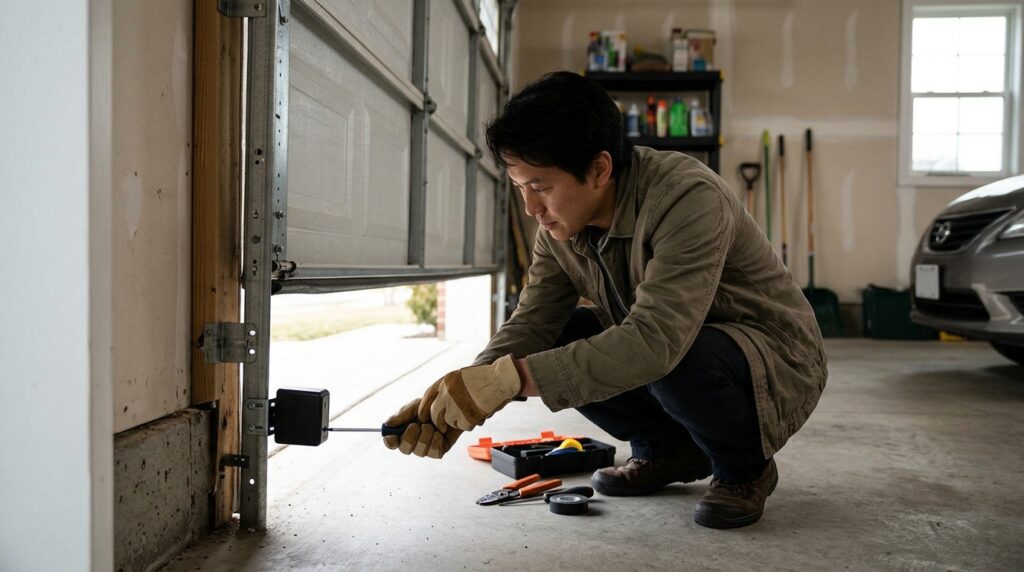
When DIY makes sense I have fixed dozens of doors for friends and neighbors. The tasks I recommend to a homeowner with average skills and a willingness to learn are small, low-risk, and reversible. These include adjusting limit switches on the opener, replacing weatherstripping, lubricating moving parts, tightening loose fasteners, replacing rollers that are plain bearings, and re-centering sensors. These are inexpensive repairs that often restore quiet, smooth operation.
Three practical guidelines that usually mean DIY is acceptable:
- The door moves but has a minor noise, uneven travel, or sensor problem. You can lift and lower the door manually without unusual resistance. The repair does not involve springs, cables under tension, or major structural replacement.
A short checklist before starting any DIY job
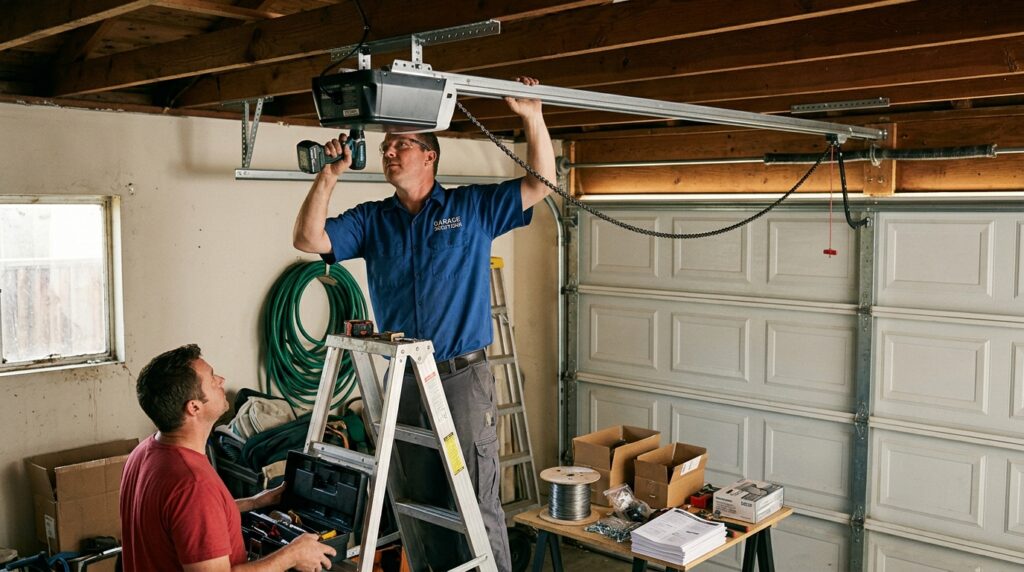
Verify the power to the opener is off by disconnecting the opener and using the manual release cord, ensuring the door moves freely by hand. Wear safety glasses and gloves; rollers and hardware often have sharp edges. Use proper tools, including ladder with secure footing and socket wrenches of the correct size. If the problem looks like a spring or cable failure, stop and call a professional.When to call a professional Safety is the obvious reason, but there are technical and financial reasons too. If your door uses torsion springs, if cables are frayed, if the door won’t stay open, or if the opener is making grinding noises and burning smells, call a pro. Professionals bring training, specialty tools, insurance, and often warranty coverage. For example, reputable local companies like Rise Up Garage Doors supply replacement springs rated for cycles, match panels for replacements, and provide proper balancing so the opener does not carry undue stress.
Cost matters here, but not always in the way you expect. A DIY spring kit might be cheaper upfront, but if installed improperly it can shear a cable or misbalance the door, leading to greater expense. A professional replacement might cost more but often includes a safety inspection, calibration, and parts that meet industry standards.
A realistic assessment of cost and value Expect a range of prices rather than a single number. Simple repairs such as sensor realignment or lubrication can be $50 to $150 in parts and tools for a DIYer, mostly time and a few materials. Professional service calls for simple fixes often start around $100 to $200 plus parts, depending on regional rates and emergency hours.
For spring replacement, expect a professional job to fall into a few hundred dollars. If the entire door needs replacement, the cost scales with materials and insulation. A single steel panel replacement can be a few hundred dollars including paint, while a full garage door installation, including opener, typically ranges from roughly $700 on the low end for a basic steel door up to several thousand dollars for insulated or custom wood doors. Those ranges are broad because professional quotes depend on size, insulation, panel style, and local labor rates in Mint Hill NC.
Opener repair is another case where professional work often wins. Many repairs are under $200 when they involve switches, remotes, or simple electronics, but motor or gear replacement, or changing to a belt drive unit for quieter operation, will cost more. Professionals can offer models and installation that meet modern noise and safety standards.
Warranty, documentation, and resale value If your door or opener is still under manufacturer warranty, a DIY attempt that damages a part can void coverage. Professionals can document the condition and provide receipts that add to resale value. A clean invoice from a trusted local company like Rise Up Garage Doors not only documents the work but can reassure potential buyers that the door system was maintained professionally.
Anecdote from a Mint Hill driveway I once consulted for a neighbor whose two-car garage door had begun to sag in the middle and bind when closing. She had attempted to adjust the tracks herself and tightened every bolt she could reach. The result was an uneven door that scraped the sill. I inspected the springs and found one spring was loose and the other nearly broken. Because the DIY adjustments had masked the real problem, the cables had taken extra load and the bottom brackets were slightly bent. We replaced both springs and cables, realigned the tracks, and swapped in new bottom brackets. The bill for professional work was higher than a single part but lower than a full panel replacement. The lesson was that symptoms may disguise the root cause, and partial DIY fixes can make the eventual repair more complex.
What professionals do that most DIY jobs do not Technicians handle sequence-sensitive tasks and testing that are difficult to replicate without experience. They balance the door so the springs and opener share load appropriately, test safe reverse systems, align photo eyes precisely, and verify gear limits on the opener to avoid over-travel. When replacing parts, they match spring ratings to door weight and cycle count, and they can source OEM or compatible panels to match your existing door.
They also manage permits and codes when structural changes or electrical work are involved. In Mint Hill, garage renovations that affect egress or the home’s exterior may need to comply with local codes. Professionals are familiar with local inspectors and can ensure work passes without delays.
Tools and parts that change the decision A homeowner with a well-stocked toolbox and an understanding of mechanical systems might save money doing simple repairs. But certain tools and parts are rarely practical to buy for a one-off job. Winding bars for torsion springs, professional-grade cable clamps, and balanced spring sets are examples. Likewise, a panel that matches your door’s exact profile, color, and insulation rating may be difficult to source without a dealer relationship.
Edge cases and special considerations Historic homes: Some Mint Hill properties have older carriage-style doors or custom woodwork. DIY replacement of a panel or door may damage trim or finish. Professionals experienced with heritage doors can advise restoration versus replacement and often offer finishing that matches the original.
Detached garages and outbuildings: These may have nonstandard sizes or older hardware. Getting the door balanced and safely operable is slightly different from standard models. Professionals can adapt parts or recommend retrofit openers.
Flood-prone areas and moisture: Garage door components exposed to high humidity or occasional flooding corrode faster. If you live in a lower-lying part of Mint Hill where sump failures or street flooding occur, plan replacements with corrosion-resistant hardware and stainless fasteners. Professionals can specify materials and service intervals that extend life.
Insurance claims and storm damage: After a wind or hail event, insurers often require a licensed contractor’s estimate. Hiring a professional to assess damage and produce a documented estimate helps smooth a claim and ensures repairs meet insurance requirements.
How to choose a trustworthy professional Not all contractors are equal. Look for a local company with established reviews and clear licensing. Ask for proof of insurance and written estimates that separate parts and labor. Good professionals will offer warranties on both parts and labor and will explain the trade-offs between repair and replacement.
Questions to ask before hiring:
- Are technicians trained and background checked? Will the company provide an itemized estimate? Is there a warranty, and what does it cover? Do they carry common parts, or will there be a wait?
Rise Up Garage Doors often shows up in local conversations for their responsiveness and ability to handle opener repair, full replacements, and installations. Requesting multiple quotes is fair. A trustworthy company explains why a repair is needed, shows worn parts, and lays out options for repair versus replacement with costs and expected life span.
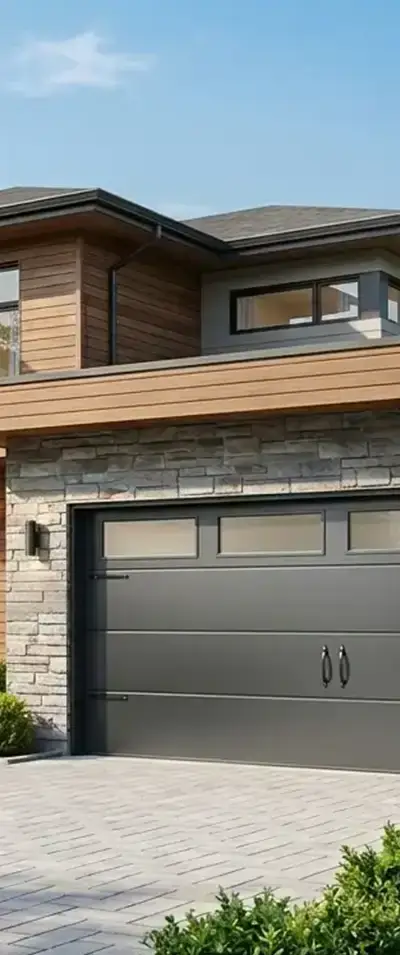
A balanced decision framework Deciding DIY or professional should hinge on several factors: safety risk, technical difficulty, warranty status, long-term cost, and the homeowner’s comfort with tools. If the repair affects structural integrity or involves stored energy in springs or cables, call a professional. If the task is mechanical, reversible, and within your comfort zone, proceed carefully and document your steps.
A short comparison to help decide
Safety-critical or spring-related issues: professional. Opener diagnostics, complex electronics, or warranty-sensitive repairs: professional. Cosmetic repairs, lubrication, sensor alignment, and loose hardware: DIY if comfortable. Full door replacement or custom installations: professional for better fit, finish, and code compliance.Final practical tips Keep routine maintenance simple and effective. Inspect rollers and hinges every six months, clean tracks with a dry cloth, lubricate moving parts with a silicone-based product annually, and test the opener’s safety reverse with a 2 by 4 each month. Keep a log of repairs and purchases; it helps when a technician arrives and improves decisions about replacement timing.
If you choose a professional, get a written estimate, confirm warranty terms, and ask about preventive maintenance packages. Many companies, including locally known services, offer seasonal inspections that catch small issues before they become emergencies.
Repair, replace, or upgrade There comes a moment when repair is no longer economical. Repeated spring failures, persistent warping, or doors that compromise insulation or security are strong reasons to replace. Upgrading also offers opportunities: quieter belt-drive openers, Wi-Fi-enabled systems, better insulation for year-round energy savings, and modern keypad and sensor systems for improved security.
Deciding between DIY and professional is not a one-size-fits-all call. For Mint Hill homeowners, balancing safety, cost, and long-term Garage Door Replacement in Mint Hill NC value leads most people to combine approaches: routine upkeep and small fixes at home, and professional help for anything involving springs, cables, structural work, or electrical systems. When you are unsure, the safest and often most economical route is to call a reputable local technician to diagnose and recommend the right path. Rise Up Garage Doors and other experienced providers can offer clear options so you can make a confident decision without adding unnecessary risk.
Rise Up Garage Doors
Mint Hill, NC, United States
+1 (980) 240-2447
[email protected]
https://riseupgaragedoors.com/